

Free Energy Savings Tool

SEER Savings Calculator for Dallas-Fort Worth

Estimate Your AC & Furnace Energy Savings | Compare Efficiency Ratings | Plan Your Upgrade

Compare SEER Ratings
Calculate Annual Savings
Project 5-15 Year ROI
Cooling & Heating Modes
LEX Air Conditioning SEER Calculator for DFW

Free Energy Savings Estimate No Obligation (972) 466-1917

Calculate Your Energy Savings

Wondering if upgrading your AC or furnace is worth it? Use our free calculator to estimate how much you could save on energy bills by switching to a more efficient system.

In North Texas, where air conditioners run 6+ months per year, the difference between an old 10 SEER unit and a new 18 SEER system can mean hundreds of dollars in annual savings.

Compare current vs. new system costs
See monthly and annual savings
Project savings over 5, 10, and 15 years
Calculate cooling (SEER) or heating (AFUE) savings

Did You Know?

Upgrading from 10 SEER to 18 SEER can save up to $9,000+ over the life of your system.

Energy Savings Calculator

Select your current and new system specs to see your estimated savings

Cooling
Heating
This calculator provides rough estimates for homes in North Texas. Savings are not guaranteed. Based on $0.156/kWh electricity, $2.41/therm natural gas, 2,300 cooling hours, and 77M BTU heating season.

Cooling Savings

0 SEER vs 0 SEER on a 0 BTU Air Conditioner

0%

Savings per year

Monthly savings: $0

Annual Energy Cost
New cost: $0
Current cost: $0
$0
5-YRS
$0
10-YRS
$0
15-YRS

Heating Savings

0 AFUE vs 0 AFUE

0%

Savings per year

Monthly savings: $0

Annual Energy Cost
New cost: $0
Current cost: $0
$0
5-YRS
$0
10-YRS
$0
15-YRS

Get a Free Quote: (972) 466-1917

Understanding SEER Ratings

What efficiency ratings mean for your energy bills

What Is a SEER Rating?

SEER stands for Seasonal Energy Efficiency Ratio. It measures how efficiently an air conditioner converts electricity into cooling power over an entire cooling season.

The formula is simple: SEER = Total cooling output (BTUs) ÷ Total electricity used (watt-hours)

Higher SEER ratings mean the unit uses less electricity to produce the same amount of cooling. For example, an 18 SEER air conditioner uses about 44% less energy than a 10 SEER unit to cool the same space.

2023 SEER2 Standards

As of January 2023, the Department of Energy introduced SEER2, a new testing method that better reflects real-world conditions. In Texas (South Region), the new minimum efficiency is:

  • Split systems: 15 SEER / 14.3 SEER2
  • Packaged units: 14 SEER / 13.4 SEER2

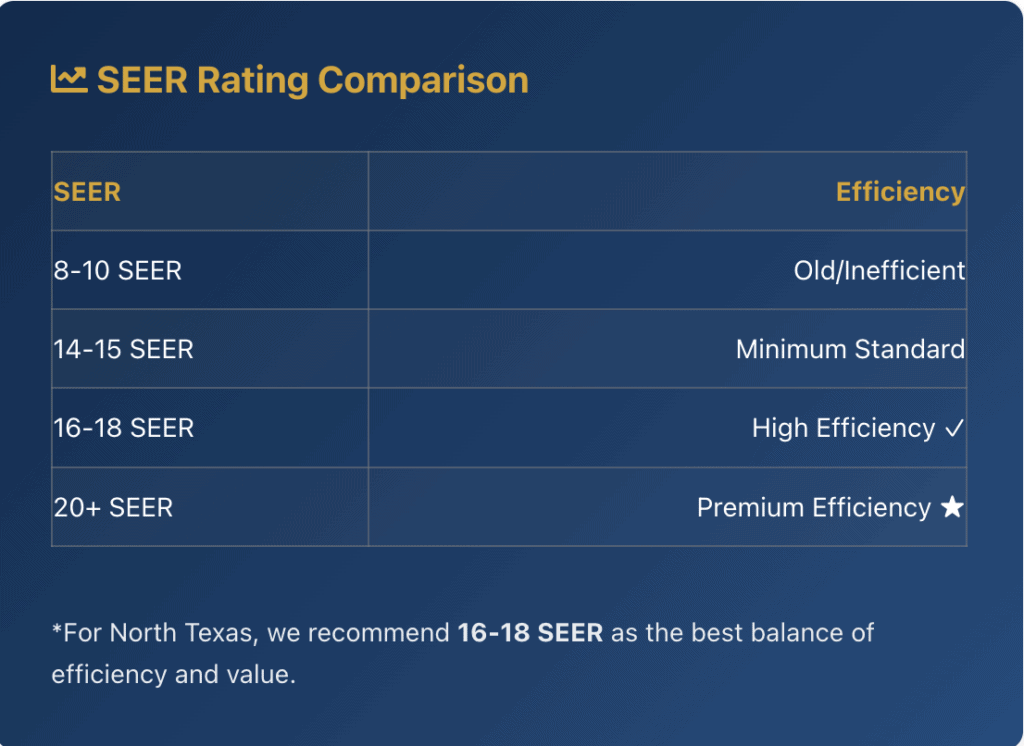
SEER Rating Comparison

SEER Efficiency
8-10 SEER Old/Inefficient
14-15 SEER Minimum Standard
16-18 SEER High Efficiency ✓
20+ SEER Premium Efficiency ★

*For North Texas, we recommend 16-18 SEER as the best balance of efficiency and value.

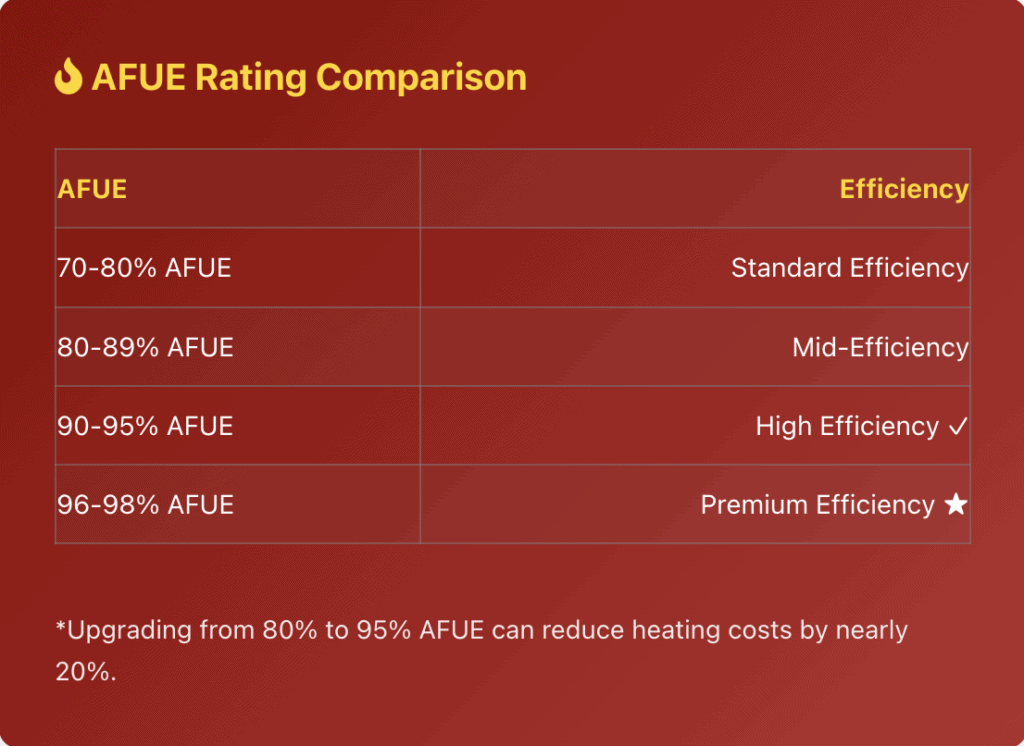
AFUE Rating Comparison

AFUE Efficiency
70-80% AFUE Standard Efficiency
80-89% AFUE Mid-Efficiency
90-95% AFUE High Efficiency ✓
96-98% AFUE Premium Efficiency ★

*Upgrading from 80% to 95% AFUE can reduce heating costs by nearly 20%.

What Is an AFUE Rating?

AFUE stands for Annual Fuel Utilization Efficiency. It measures how efficiently a furnace converts fuel (typically natural gas) into heat over a heating season.

An AFUE of 95% means that 95% of the fuel is converted to heat for your home, while only 5% is lost through exhaust gases. The higher the AFUE, the more heat you get from each dollar spent on gas.

Condensing vs. Non-Condensing Furnaces

Furnaces with 90%+ AFUE are called "condensing" furnaces because they capture heat from exhaust gases that would otherwise be wasted. These units are more efficient but require special venting.

In North Texas where winters are mild, a 90-95% AFUE furnace typically provides the best return on investment.

Benefits of High-Efficiency HVAC Systems

More than just energy savings

Lower Energy Bills

High-efficiency systems use significantly less electricity and gas, reducing your monthly utility costs by hundreds of dollars per year.

Quieter Operation

Modern high-SEER units feature variable-speed compressors and advanced sound insulation, running up to 50% quieter than older models.

Better Humidity Control

Variable-speed systems run longer at lower speeds, removing more moisture from the air and keeping your home more comfortable.

Consistent Temperatures

Advanced systems eliminate hot and cold spots by delivering precise, even cooling and heating throughout your home.

Reduced Carbon Footprint

Using less energy means fewer greenhouse gas emissions. A high-efficiency system is better for your wallet and the environment.

Rebates & Tax Credits

Many high-efficiency systems qualify for utility rebates and federal tax credits, reducing your upfront investment.

SEER & Energy Efficiency FAQs

What is a SEER rating?

SEER stands for Seasonal Energy Efficiency Ratio. It measures how efficiently an air conditioner converts electricity into cooling over a typical cooling season. Higher SEER ratings mean greater energy efficiency and lower operating costs. As of 2023, the minimum SEER rating for new AC units in Texas is 15 SEER (or 14.3 SEER2). The higher the number, the less electricity your AC uses to cool your home.

What is the difference between SEER and SEER2?

SEER2 is the updated testing standard introduced in January 2023 that measures efficiency under conditions that more closely simulate real-world installation, including higher external static pressure. SEER2 ratings are typically about 4.7% lower than SEER ratings for the same equipment. A 15 SEER unit is roughly equivalent to a 14.3 SEER2 unit. When shopping for a new AC, you may see both ratings listed - they describe the same equipment, just measured differently.

How much can I save by upgrading to a higher SEER AC?

Savings depend on your current system's efficiency, the new system's efficiency, and how much you use your AC. For example, upgrading from a 10 SEER to an 18 SEER system on a 3-ton AC can save approximately $400-600 per year on cooling costs in North Texas. Over 15 years, that's $6,000-9,000 in energy savings - often more than the difference in equipment cost. Use our calculator above to estimate your specific savings based on your system size and current efficiency.

What SEER rating should I choose for my new AC?

For North Texas homes, we typically recommend 16-18 SEER systems as the best balance of efficiency and upfront cost. A 16 SEER unit offers solid efficiency at a reasonable price point, while 18 SEER provides excellent long-term savings. Higher SEER units (20+) offer maximum efficiency but have higher upfront costs that take longer to recoup. Our comfort advisors can help you determine the best option based on your home size, budget, and usage patterns.

What is AFUE rating for furnaces?

AFUE stands for Annual Fuel Utilization Efficiency and measures how efficiently a furnace converts fuel (natural gas) into heat over a heating season. An AFUE of 95% means 95% of the fuel becomes heat for your home while only 5% is lost through exhaust gases. Standard furnaces are 80% AFUE, while high-efficiency models are 90-98% AFUE. In North Texas where winters are mild, a 90-95% AFUE furnace typically provides the best return on investment.

Is a higher SEER AC worth the extra cost?

In Texas where cooling seasons are long and hot (6+ months), higher SEER systems often pay for themselves through energy savings within 5-8 years. Additionally, high-efficiency systems typically run quieter due to variable-speed technology, provide better humidity control, maintain more consistent temperatures, and may qualify for utility rebates and federal tax credits. For most DFW homeowners who plan to stay in their home 5+ years, a higher SEER unit is a smart investment.

How accurate is this SEER savings calculator?

Our calculator provides reasonable estimates based on average North Texas conditions: $0.156/kWh electricity rates, 2,300 cooling hours per season, and standard equipment performance. Your actual savings may vary based on your specific electricity rates, home insulation, thermostat settings, and usage patterns. The calculator is designed to give you a ballpark figure to help with decision-making. For a precise estimate tailored to your home, schedule a free consultation with our comfort advisors.

What rebates are available for high-efficiency HVAC systems?

Several rebates and incentives may be available: utility company rebates (Oncor, TXU, etc. often offer $200-$500 for high-efficiency installations), federal tax credits (up to $2,000 for qualifying heat pumps and high-efficiency systems under the Inflation Reduction Act), and manufacturer rebates (seasonal promotions from Trane, Carrier, Lennox, etc.). Our team stays current on available incentives and will help you maximize your savings. Rebates can significantly offset the cost difference of upgrading to higher efficiency.

Ready to Start Saving?

Get a free, no-obligation quote on a high-efficiency AC or furnace installation.

The Gold Standard of White Glove Service • Family-Owned Since 2004