

Qmerit-certified electricians installing Tesla, Rivian, Ford & all Level-2 EV charging stations

Electric vehicle adoption is accelerating across the Dallas-Fort Worth metroplex as more drivers switch to cleaner, more cost-efficient transportation. Installing an EV charging station at your home eliminates the hassle of relying on public charging stations—you can safely charge overnight in your own garage while you sleep, waking up to a fully charged vehicle every morning.
LEX Air Conditioning offers professional EV charger installation services throughout the DFW area, backed by Qmerit certification and over 20 years of electrical expertise. Our licensed electricians install all major EV charger brands including Tesla Wall Connectors, Rivian Wall Chargers, Ford Charge Station Pro, ChargePoint, JuiceBox, and universal Level-2 charging stations.
Federal Tax Credit Available: Get up to 30% back (max $1,000) on installation costs with the Alternative Fuel Vehicle Refueling Property Credit. We provide all documentation needed for your tax filing.
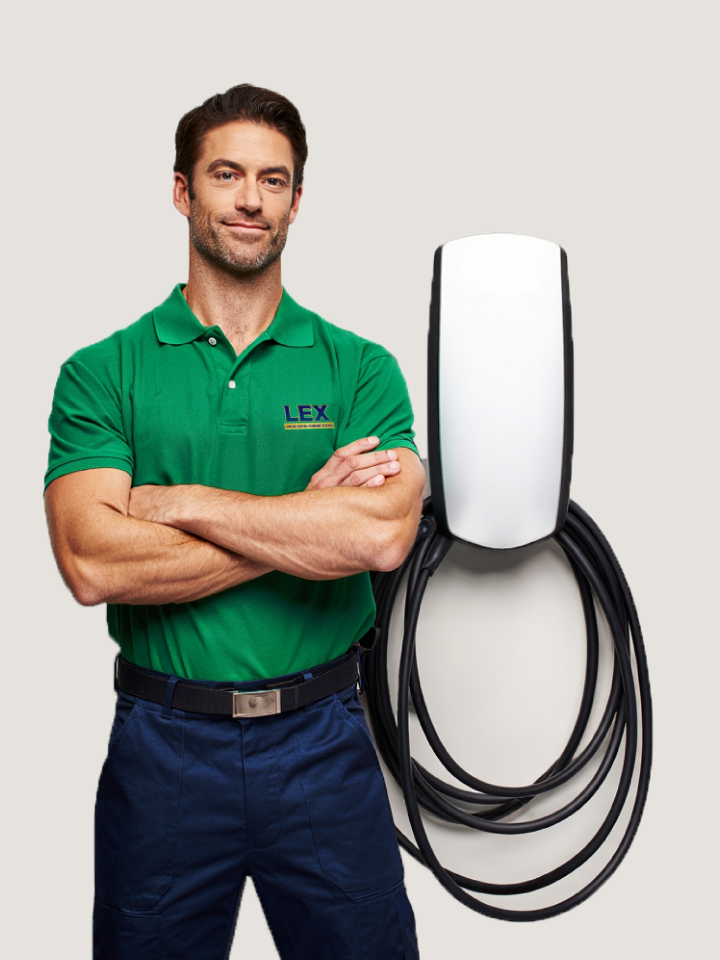
Qmerit-certified professionals backed by three generations of electrical expertise.
Every EV charger installation is completed by a Qmerit-certified installer—background-checked professionals trained in EV charging standards, safety codes, and best practices for all major EV brands.
We install Tesla Wall Connectors, Rivian chargers, Ford Charge Station Pro, ChargePoint, JuiceBox, Wallbox, and all universal Level-2 charging stations for any electric vehicle make or model.
Our master electricians (TECL #23192) handle every aspect of installation—electrical panel assessment, permit applications, dedicated circuit installation, and final inspection.
Federal tax credits cover up to 30% of installation costs (max $1,000). We provide detailed receipts and documentation to help you claim the Alternative Fuel Vehicle Refueling Property Credit.
Three generations of electrical expertise serving DFW families and businesses. We've installed thousands of electrical systems across the metroplex since 2004.
From single home chargers to multi-unit commercial charging networks, we handle projects of all sizes. We install charging stations for homes, apartments, offices, and fleet depots.
Convenience, cost savings, and energy independence that public charging can't match.
Never visit a public charging station again—simply plug in when you park at night and wake up to a fully charged vehicle every morning. No more sitting in parking lots waiting 30-60 minutes for a charge. With a Level 2 home charger, you'll gain back hours each week.
Home electricity rates in Texas average $0.11-0.13 per kWh—dramatically cheaper than public fast charging stations that charge $0.30-0.60 per kWh (3-5x higher!). For a typical EV driver, charging at home saves $800-1,200 per year compared to public charging.
Level 2 home EV chargers operate on 240-volt circuits and deliver 12-60 miles of range per hour—up to 10x faster than standard 120-volt outlets. Most EVs fully charge in 4-8 hours overnight, ensuring you're ready for your daily commute.
Professional installation by licensed, Qmerit-certified electricians ensures your charging system is installed safely and correctly. We install dedicated circuits with proper breakers, GFCI protection, and code-compliant wiring rated for outdoor/garage environments.
EV charging stations are highly desirable for homebuyers. A 2023 Zillow study found homes with EV chargers sell for 2-4% more than comparable homes without charging. It also future-proofs your home for the transition to electric transportation.
Charging your EV at home with Texas electricity (which includes significant wind and solar generation) produces fewer emissions than gasoline vehicles. Over a vehicle's lifetime, an EV charged with Texas grid electricity produces 60% fewer emissions than a comparable gasoline vehicle.
Get up to 30% back with the federal tax credit. Call for a free consultation.
Code-compliant installation from consultation to final inspection.
We begin with a thorough consultation to understand your electric vehicle, daily driving habits, and charging needs. We help you select the right EV charger based on your vehicle, desired charging speed, smart features, installation location, and budget.
Our licensed electricians conduct a comprehensive site assessment of your electrical system and proposed charger location. We inspect your main electrical panel capacity, measure distance from panel to charging location, evaluate circuit availability, and check for necessary upgrades.
EV charger installations require electrical permits in most DFW municipalities—we handle all permitting and code compliance for you. We file required permits, ensure NEC compliance, follow local requirements, and coordinate municipal inspections after installation.
Our certified electricians complete your installation with meticulous attention to safety. We install a dedicated 40-60 amp circuit, run proper wiring, mount the charging unit securely, complete all connections, and perform comprehensive testing to ensure proper operation.
Installation Timeline: Most residential EV charger installations are completed in 4-6 hours (single day service). Projects requiring electrical panel upgrades may take 1-2 days.
Choose the right charging solution for your needs.
120V Standard Outlet
Charging Speed: 3-5 miles per hour
Full Charge: 24-48 hours
Best For: Emergency use only
Standard 120-volt household outlet. Slowest charging option—only practical for plug-in hybrids with small batteries. Not recommended for full EVs.
240V Dedicated Circuit
Charging Speed: 12-60 miles per hour
Full Charge: 4-8 hours
Best For: Home & workplace charging
Recommended for homes! Operates on 240-volt circuits (like your dryer). Charges overnight while you sleep. This is what we install most often.
480V+ Commercial Power
Charging Speed: 100-200+ miles per hour
Full Charge: 20-60 minutes
Best For: Commercial/public stations
Requires expensive commercial infrastructure ($50,000-150,000). Only needed for public charging stations, fleet operations, and highway rest stops.
We install all major EV charging station brands, including:
Tesla Wall Connector • Rivian Wall Charger • Ford Charge Station Pro • ChargePoint Home Flex • JuiceBox • Wallbox Pulsar Plus • Emporia • Grizzl-E • ClipperCreek • Autel MaxiCharger • Enel X JuiceBox • Siemens VersiCharge • Leviton Evr-Green • Webasto • Flo Home • And More
Don't see your charger brand? We install all UL-certified Level-2 EV charging stations. Call us for a free consultation: (972) 466-1917
Installation costs vary based on the complexity of the job and your electrical system. Here's what to expect:
$800 - $1,500
$2,000 - $4,000+
The Alternative Fuel Vehicle Refueling Property Credit provides a 30% tax credit on EV charger installation costs, up to $1,000 maximum.
Example: If your installation costs $2,000, you'll receive a $600 tax credit. If it costs $4,000+, you'll receive the maximum $1,000 credit. We provide all documentation needed for your tax filing.
Common questions about installing an EV charging station at home.
Most residential EV charger installations are completed in 4-6 hours (single day service). The installation involves running a dedicated 240-volt circuit from your electrical panel to the charger location, mounting the charging unit, making all electrical connections, and testing the system. Projects requiring electrical panel upgrades or extensive conduit runs (50+ feet) may take 1-2 days. We provide accurate time estimates during your consultation.
It depends on your existing electrical panel capacity and available circuit breaker slots. Most modern homes built after 2000 have 200-amp panels with sufficient capacity for an EV charger. Older homes with 100-amp panels often require upgrades, especially if you're already running multiple high-draw appliances (central AC, electric dryer, electric range). Our electricians will assess your panel during the site evaluation and provide honest recommendations. Panel upgrades typically cost $1,500-3,000 but may be necessary for safe operation.
Yes! Garages are the most common location for residential EV charger installations. We can mount the charging unit on any garage wall with access to your electrical panel. The charger should be located where you'll park your EV, typically on the wall directly in front of or beside the parking space. Make sure your garage door can still operate freely and you have enough cord length (usually 18-25 feet) to reach your vehicle's charging port. We can also install outdoor chargers on exterior walls, driveways, or carports using weatherproof equipment.
Hardwired chargers are permanently connected to your home's electrical system without a plug—wired directly into a junction box. Plug-in chargers connect via a NEMA 14-50 or NEMA 6-50 outlet (similar to dryer outlets). Hardwired installations are more permanent and slightly less expensive (no outlet required). Plug-in chargers offer portability—you can unplug and take the charger with you if you move, or swap between multiple charging locations. Both are equally safe and perform identically. We recommend hardwired for permanent installations and plug-in if you might relocate or want flexibility.
Yes, in most Dallas-Fort Worth municipalities, electrical permits are required for EV charger installations because you're adding a new dedicated 240-volt circuit to your home's electrical system. Permits ensure installations meet National Electrical Code (NEC) safety standards and local building codes. We handle all permit applications and coordinate the required electrical inspections on your behalf—you don't need to visit the permit office or deal with inspectors. Proper permitting protects you from liability, maintains equipment warranties, and ensures your installation passes scrutiny during home sales.
Yes and no. Tesla Wall Connectors come in two versions: Tesla-only (with proprietary connector) and Universal (with J1772 standard connector). If you have a non-Tesla EV (Rivian, Ford, Nissan, BMW, etc.), you'll need a Universal charger with a J1772 connector—the industry standard used by all non-Tesla EVs. We can help you select the right charging equipment for your specific vehicle. Many Tesla owners also choose universal J1772 chargers because they work with all EVs, providing future flexibility if you switch vehicle brands.
Proudly serving the entire Dallas-Fort Worth metroplex and surrounding communities.
Qmerit-certified installation by licensed electricians. Federal tax credit eligible (30%, max $1,000).
Open 24/7 for emergency electrical service in the Dallas-Fort Worth area.
